
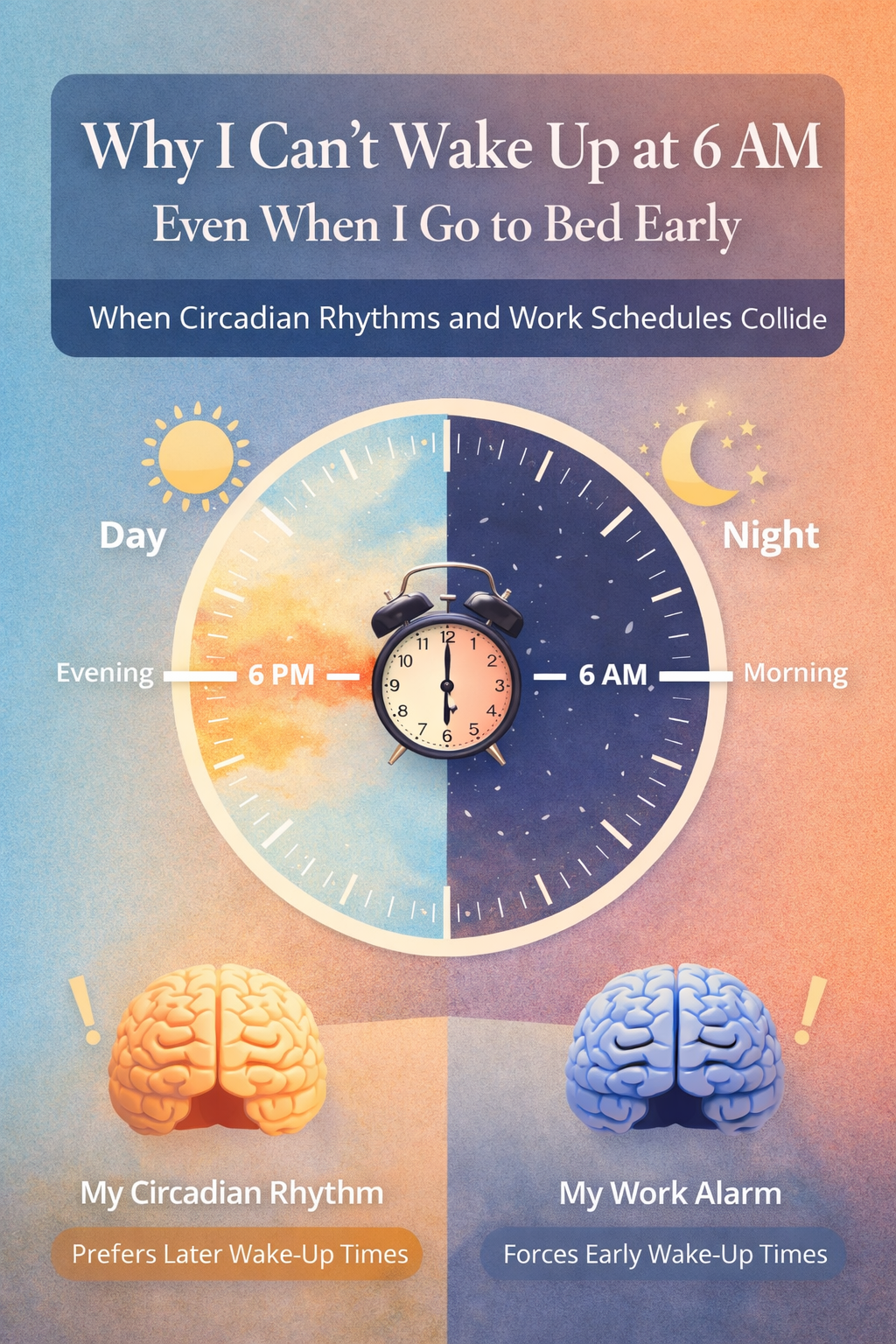

This Is Not a Willpower or Discipline Problem
✍️ By Angelic Muse
For a long time, I assumed this was a discipline problem.
I went to bed earlier. Sometimes extremely early. Between 6:30 and 8:00 pm.
I simplified my mornings. I skipped steps. I rushed. I tried to “do better.”
And I still struggled to wake up at 6:00 am.
I still felt foggy and slow.
I still felt behind before the day even started.
Eventually, I had to ask a different question. What if this is not a motivation problem at all?
One of the most common myths about exhaustion is that it can always be solved by going to bed earlier. Sleep science does not support that idea.
If someone consistently gets enough sleep and still struggles to wake up, the issue is rarely effort. It is usually related to sleep quality, circadian rhythm alignment, or chronic nervous system stress.
If you can go to bed early and still wake up exhausted, your body is not failing. It is responding to conditions.
Circadian Rhythm Mismatch and Morning Exhaustion
Humans do not all run on the same internal clock.
Research shows that people have different chronotypes. Some are biologically wired to wake earlier. Others are wired to wake later.
When someone with a later chronotype is forced into an early schedule, the result often includes:
• Extreme morning grogginess
• Slow thinking and movement
• Difficulty completing basic tasks
• Chronic lateness despite best efforts
This can happen even when total sleep time is adequate. In effect, the body experiences something similar to daily jet lag.
How Job Stress and Burnout Affect Sleep Quality
This is not about attitude or mindset.
Occupational health research shows that chronic job stress, low autonomy, and dissatisfaction directly affect sleep architecture.
Specifically:
• Cortisol rhythms can become disrupted
• Deep sleep can become fragmented
• Morning alertness can be reduced
This means someone can be asleep for eight or nine hours and still wake up feeling unrefreshed. The nervous system never fully powers down.
Why Rushing Mornings and Skipping Steps Did Not Help
Cutting corners did not fix the problem. That detail matters.
When time-saving strategies fail, it usually means the issue is not time management. It is cognitive and physiological readiness.
Morning executive function depends on:
• Sleep depth
• Circadian alignment
• Stress hormone regulation
When these systems are strained, everything takes longer. Not because of laziness, but because the brain is operating at reduced capacity.
Burnout, Depression, and Circadian Issues Are Not the Same Thing
These states are often confused, but they are not identical.
Burnout often looks like:
• Energy returning on weekends or time off
• Fatigue tied primarily to workdays
• Motivation intact for things that matter
Circadian rhythm mismatch often looks like:
• Persistent morning struggle regardless of sleep duration
• Slow starts even on non-workdays
• Energy improving later in the day
Depression includes:
• Persistent low mood
• Loss of pleasure across multiple areas
• Fatigue that does not lift with rest
From experience alone, depression cannot be confirmed. Burnout and circadian misalignment fit more closely with this pattern.
Can Disliking a Job Make You Feel Exhausted?
Yes, and not in a simplistic way.
Motivation and wakefulness are biologically linked. Dopamine plays a role in morning activation. When the day ahead feels unrewarding or draining, dopamine release can be blunted. This makes it harder for the body to mobilize energy.
This is not weakness. It is neurobiology. The body conserves energy when it does not anticipate reward or agency.
What Chronic Morning Fatigue Is Actually Telling You
This experience is not a moral failing.
It is not laziness.
It is not lack of discipline.
It is not something that can always be fixed by trying harder.
It is often a signal of:
• Circadian rhythm mismatch
• Chronic stress or burnout
• A nervous system stuck in low-grade survival mode
These are solvable problems, but they are not solved through shame.
One Question That Helped Me Understand My Sleep Pattern
On days without an alarm, when do you naturally wake up, and how do you feel within the first hour?
That answer often reveals more than any productivity system ever could.
Your body is not betraying you.
It is reporting conditions.
Listening to that data is not weakness.
It is the beginning of self-trust.
Honoring the data within,
Angelic
Welcome Home. 🌵✨