
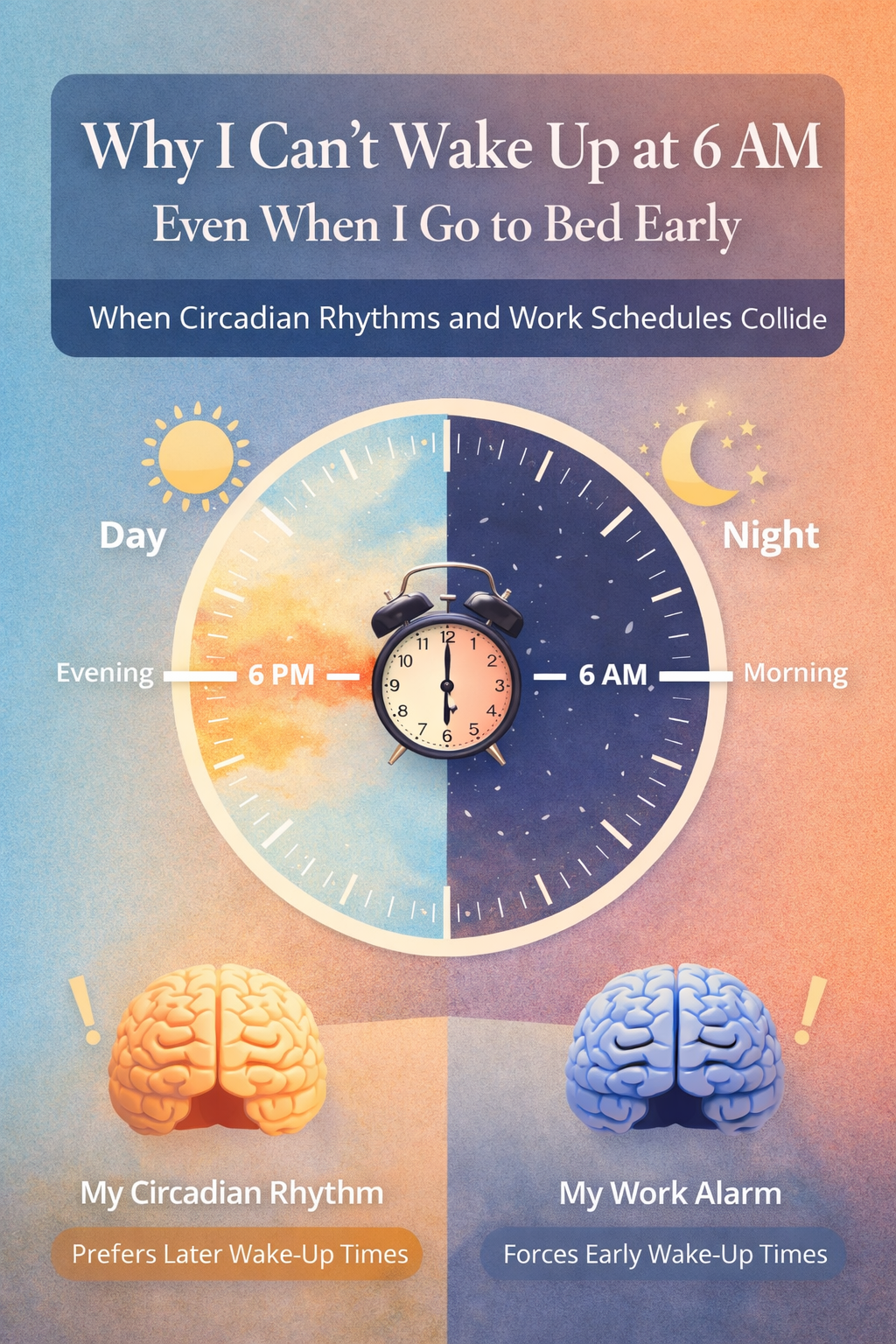

This Is Not a Willpower or Discipline Problem
✍️ By Angelic Muse
For a long time, I thought this was a discipline issue.
Go to bed earlier. Be more responsible. Try harder.
So I did.
I went to bed early. Sometimes really early, like 6:30 or 8:00 pm.
I simplified my mornings. Skipped steps. Tried to move faster.
And still… 6:00 am felt awful.
I’d wake up foggy, slow, and already behind before the day even started.
At some point, I had to ask a different question.
What if this isn’t about motivation at all?
Going to Bed Earlier Didn’t Fix It
There’s this idea that if you’re tired, the solution is always more sleep or earlier sleep.
That wasn’t my experience.
I could get a full night of sleep and still wake up feeling like my body wasn’t ready. Like I was being pulled out of something unfinished.
That’s when it started to click that this might not be about effort.
Not Everyone Runs on the Same Internal Clock
We don’t all wake up the same way.
Some people naturally feel good early. Others don’t.
If you’re wired a little later, forcing a 6 AM schedule can feel like constant jet lag, even if you’re technically getting enough sleep.
That explains a lot more than “I just need more discipline.”
Stress and Burnout Matter More Than You Think
This part is easy to overlook.
When you’re dealing with stress, burnout, or just not feeling aligned with your day, your body doesn’t fully settle at night.
So even if you’re asleep, you’re not getting the kind of rest that actually restores you.
Then morning comes, a
nd it feels like you never really shut off.
Why Rushing Didn’t Help
I tried cutting things out of my morning.
Tried rushing. Tried being more efficient.
It didn’t fix anything.
That’s when I realized it wasn’t a time issue.
It was how I was functioning when I woke up.
When your brain feels slow, everything takes longer.
That’s not laziness. That’s capacity.
It’s Not Always What You Think
It’s easy to label this the wrong way.
It can look like burnout.
It can look like “not a morning person.”
It can feel like something is wrong.
But for me, the pattern was simple:
No matter how early I went to bed, mornings were still hard.
Later in the day, I felt more like myself.
That told me something important.
What You’re Waking Up To Matters
This part is real.
If the day ahead feels draining, overwhelming, or misaligned, your body knows that.
There’s a connection between how you feel about your life and how your body shows up for it.
So if waking up feels hard, it’s not always about sleep.
Sometimes it’s about what you’re waking up to.
What This Is Actually Telling You
At some point, I stopped making this a character flaw.
This isn’t laziness.
It’s not a lack of discipline.
And it’s not something you can always fix by pushing harder.
Sometimes it’s your natural rhythm.
Sometimes it’s stress.
Sometimes it’s your body asking for something different.
A Better Question to Ask
Instead of asking “why can’t I wake up early,” try this:
If you don’t set an alarm, when do you wake up naturally?
And how do you feel when you do?
That answer will tell you more than any routine ever could.
Your body isn’t working against you.
It’s responding to what’s going on.
And paying attention to that isn’t weakness.
It’s where things start to shift.
Honoring the data within,
Angelic 
